
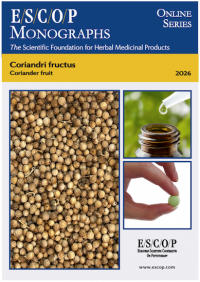
ESCOP monographs The Scientific Foundation for Herbal Medicinal Products. Online series. Coriandri fructus (Coriander fruit). Exeter: ESCOP; 2026.
Coriandri fructus
Coriander fruit
Coriandrum sativum L.
Published: November 2026
PDF, 15 pages
Online viewing (for only ¤30 per year, you can view online all the monographs; free for members of societies belonging to ESCOP)
Summary
Herbal drug definition
Coriander fruit consists of the dried cremocarp of Coriandrum sativum L.
Main characteristic constituents
- Essential oil, predominantly D-(+)-linalool (60-70%) and monoterpene hydrocarbons
- Fatty acids
- Hydroxy- and furanocoumarins
- Flavonoids and catechin derivatives
- Amides and amino acids
- Phenolcarbonic acids
These constituents are considered relevant to the pharmacological profile of the herbal drug, although their individual contribution to the clinical effects has not been fully established.
According to the ESCOP monograph, coriander fruit is mainly considered for its traditional use in supporting digestive functions for mild digestive complaints, including:
- Loss of appetite
- Complaints of the upper abdomen
- Prevention of diarrhoeal diseases
Administration and clinical use aspects
The ESCOP monograph provides information on the practical and clinical use of coriander fruit, including:
Posology: Oral use: 0.1 g coriander fruit two to three times daily. Topical use: 6% coriander fruit in ointment
Duration of use: No restriction
Contra-indications: None known
Special warnings/precautions: Coriander fruit possesses a weak potential for sensitization
Interactions with other medicinal products and other forms of interaction: None known
Use in pregnancy and lactation: No data available
Undesirable effects: Coriander fruit is known to give rise to allergic reactions
Overdose: No cases reported
Pharmacological evidence
In vitro experiments
In vitro studies with coriander fruit or its constituents have reported several biological activities, including:
- Anti-inflammatory activity
- Anti-bacterial activity
These findings help to describe possible mechanisms of action, but they should not be interpreted as direct evidence of clinical efficacy in humans
In vivo experiments
In vivo studies with coriander fruit or its extracts have described:
- Hepato- and nephroprotective properties
- Anti-hyperglycaemic properties
- Anti-inflammatory properties
- Anti-hyperlipidaemic properties
- Cardioprotective properties
- Sedative, anxiolytic and neuroprotective properties
These experimental findings support further investigation of the herbal drug, but their translation into clinical practice requires caution
Clinical studies
Clinical studies have mainly investigated effects related to metabolic syndrome:
- Hypo-glycaemic effects
- Hypo-lipidaemic effects
- Anti-oxidant effects
Safety data
Preclinical safety data for coriander fruit have been assessed in toxicity studies. The allergic potential of the herbal drug has also been evaluated in human specific IgE, skin prick and basophil activation tests. As with other herbal drugs, attention should be paid to patients with known hypersensitivity, patients with hepatobiliary disorders and pregnant or breastfeeding women.
Clinical interpretation
- Coriander fruit is mainly relevant for mild digestive complaints;
- experimental pharmacological findings should be distinguished from established therapeutic indications;
- safety, contraindications, possible interactions and duration of use must be considered before recommendation;
- persistent, severe or unexplained symptoms require medical assessment.
Literature selection
The selection of literature cited in the monograph is aimed at bringing together relevant information about the possible physiological roles of coriander fruit and its major constituents.
Keywords:
- Coriandri fructus;
- coriander fruit;
- Coriandrum sativum L.;
- digestive disorders;
- loss of appetite;
- complaints of the upper abdomen;
- prevention of diarrhoea.